Why Do Good Games Have No One Playing Them?
Suppose you spent three years and finally finished a game you're very happy with.
You upload it to Steam and click publish.
What happens?
In 2025, Steam released more than 20,000 new games. Yours is just one of them.
"If you're an ordinary player and you open Steam today, why would you discover one particular unfamiliar indie game among them?"
74% of positively reviewed games have cumulative sales of no more than 500 on Steam.
Just because you made the game doesn't mean anyone will play it.
Game Quality and Commercial Performance Are Not the Same Thing.
Behind every successful game there is reliable publishing.
For example, Balatro on Steam
It looks like a very successful solo-made indie game, but it couldn't have happened without publishing:
Its publisher Playstack is a professional company with about 70 employees and annual revenue of over £50 million.
- About 8 months of publishing preparation: From signing in July 2023 to official release in February 2024, it continuously carried out marketing, media PR, publishing coordination, and other work.
- Streamer marketing: It targeted content creators in the card game space and held a 24-hour invitational with 6 streamers, preparing a total of 700 Steam Keys as competition rewards.
- Steam events: It promoted the Demo around the timing windows of two Steam Next Fests, and officially participated in the February 2024 Next Fest.
- Trailer production: A professional team including creative direction, scripting, editing, motion graphics, marketing, and PR roles participated in making the Trailer.
- Multi-platform release: Launch covered PC, Switch, PlayStation, and Xbox, then expanded to mobile.
- Long-term brand operation: After launch, it released 4 batches of Friends of Jimbo crossover updates, involving many well-known game IPs such as The Witcher, Stardew Valley, and Cyberpunk 2077, and carried out collaborations including physical editions, merchandise, and live-action promotional ads.
- Daily social media operation: Posting game memes, Joker-related content, interactive posts, and holiday promotions.
- Community maintenance: Organizing player discussions and responding to questions on Discord, gradually bringing streamer audiences into the game community.
- IP crossover promotion: Producing announcements, visual assets, and short videos for crossovers with The Witcher, Cyberpunk 2077, and others.
- Creative marketing: Inviting actor Ben Starr to play Jimbo, shooting a live-action ad, and using the footage for subsequent social media promotion.
This course is here to talk about what else a game needs besides making the game itself, and how to do it.
Next, everyone should take a game you like as an example and search for what work was done beyond the game's own development (and how you know about it), then share it in a bit.
How Do Players Discover a Game?
We just saw that publishers do a lot of work.
But why do these things?
Suppose there is a player who has never heard of Balatro.
He might first see a streamer playing the game on Bilibili.
He finds it a bit interesting, so he searches for it on Steam.
He enters the store page and looks at screenshots, the Trailer, and player reviews.
If interested, he might first add it to his wishlist, or download the Demo to try it.
Only in the end might he decide to buy it.
The whole process can be simply understood as:
Discover the game → Become interested → Learn more → Take action
Look back at the publishing work just introduced:
- Streamer collaborations, social media, and expos: help more players discover the game.
- Trailers, screenshots, and promotional copy: let players quickly understand the game and become interested.
- Store page, Demo, and player reviews: help players learn more and judge.
- Launch events and discount promotions: push players to try or buy.
These steps are not completely independent, and not every player will act in this order.
But they are all solving the same problem:
How do you get someone who originally didn't know the game to eventually be willing to play it?
And among this work, one kind of material is especially important.
It can appear on the Steam store page, at game showcases, and at expos, and can also be cut into short videos for social media.
If you only had one minute to make a stranger understand what's fun about a game, what would you do?
This is what we'll talk about next: the Game Trailer.
What Is a Game Trailer?
Atrio: The Dark Wild - Early Access Launch Trailer - YouTube
What game is this, what's the setting—survival, exploration, automation
I Made the Worst Firewatch Trailer Ever — Derek Lieu Creative - Game Trailer Editor
The Worst Possible Trailer For Firewatch v2
What game is this, what's the setting—actually it's not a survival game hhh
- Let the audience understand the gameplay: Start from a simple goal and gradually introduce the game's core mechanics.
- Let the audience feel the fun: Through escalating complexity and humorous narration, show the unique experience of an automation game.
- Let the audience feel anticipation: Make players wonder—how far can this system develop next? A good Trailer doesn't show everything in the game; it lets the target players see, within a limited time, the part of the game most worth experiencing.
Game Features != Game Selling Points
Developers are very familiar with gameplay, but may not be able to package it into selling points.
This course is here to teach everyone how to create selling points so the game can sell.
For example, suppose there is an automation building game.
The developer might introduce it like this:
Our game includes systems such as automated production lines, resource collection, animal capture, and building construction.
This is not wrong, but it's not appealing.
Switch to player-facing expression:
To grow a single mushroom, you have to build an entire automated factory.
Why is the latter more appealing?
Because it not only tells players what's in the game, but also lets them imagine what they will experience.
Balatro is a roguelike card game based on poker rules. The game includes multiple poker hand types, 150 Joker cards, different types of Tarot cards and Planet cards, as well as systems such as shop purchases, deck building, deck upgrades, random events, and multiple game modes. Players can score by combining different card effects and gradually complete level challenges.
Balatro is a poker trip that never stops looping. In this intoxicating strategy-building game, you'll take part in illegal card games, discover Joker cards that can change the situation, and set off a series of blood-pumping, wildly bursting chain reactions.
Gameplay + experience = selling point
I often said this when you were making opage.
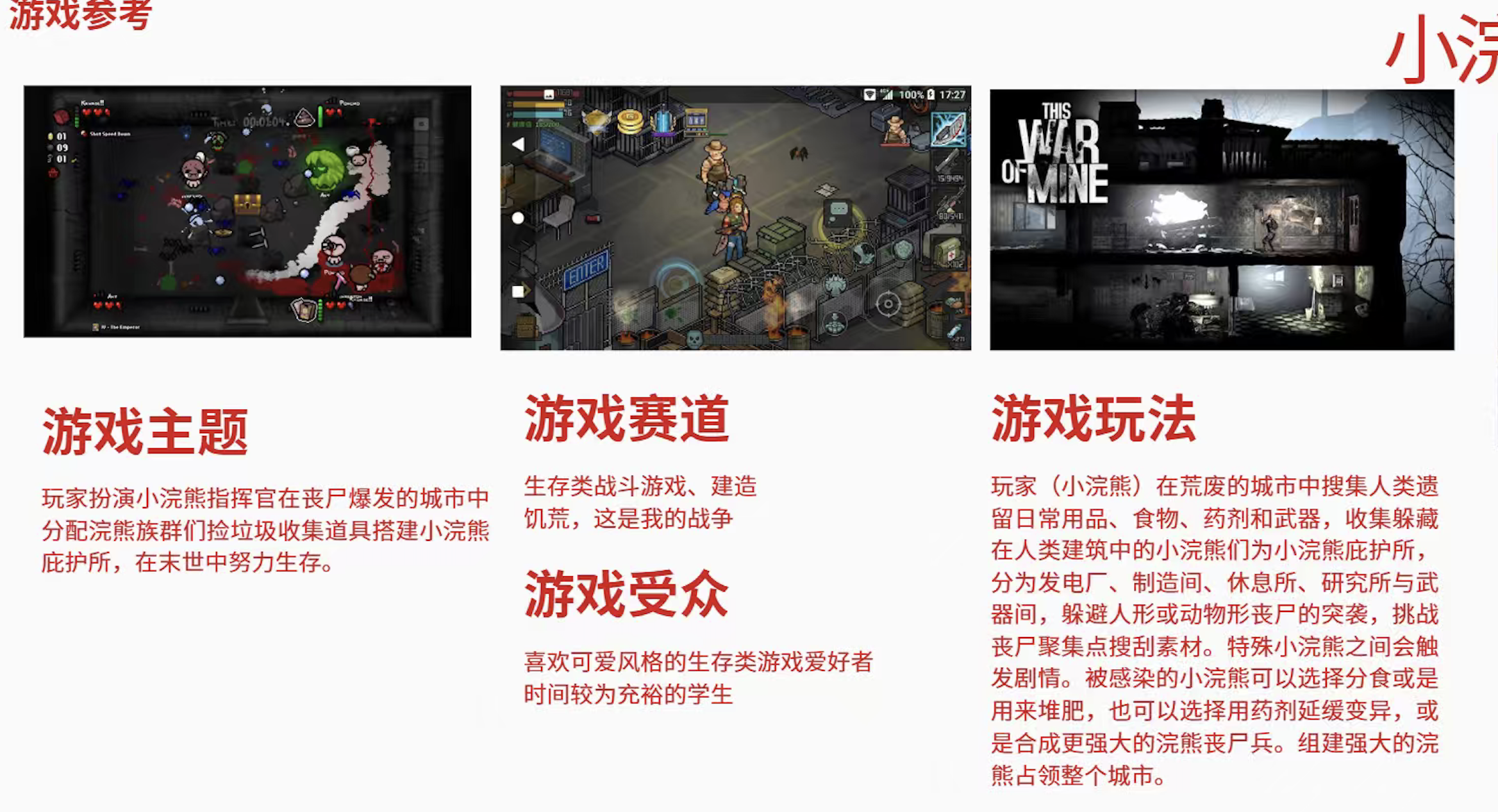
Lead a group of raccoons who are good at digging through trash cans to scavenge supplies and build shelters in a zombie-infested apocalyptic city, gradually turning a ruin into a furry raccoon home!
Don't just tell people what features the game has; make them understand why these features are fun.
Practice
Task: Make a one-page promotional sheet for a game you like.
Only four things are needed:
- Introduce the game in one sentence, trying to highlight its unique experience.
- Choose the three selling points you most want to promote.
- Find one game screenshot that can prove each selling point.
- Explain why you chose these three things instead of other features.
Share...
Conclusion: these screenshots are the material that will ultimately be used to make the promotional video.
Will other people be interested? Not necessarily.
The same game should be promoted to what kind of players? Will different players be attracted by the same selling points?
This is what we'll discuss in the next lesson: Game positioning, target players, and selling point refinement.
Looking forward to your next article!
thx!